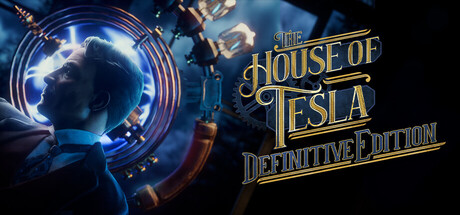
The House of Tesla: Definitive Edition
Blue Brain Games' most gorgeous puzzle adventure yet, set inside a beautifully realized Wardenclyffe Tower — undercut by a clunky interface and a narrative that even the studio's own longtime fans call a step down from The House of Da Vinci trilogy.
Media
Blue Brain Games built its reputation on The House of Da Vinci trilogy, a series that earned comparisons to Fireproof Games’ The Room as one of the better first-person puzzle-box adventures around. The House of Tesla is the Slovak studio’s follow-up subject: Nikola Tesla’s real, ill-fated Wardenclyffe Tower project, his 1903 attempt at free wireless electricity transmission. It launched in September 2025, and the version reviewed here is the Definitive Edition — a later revision of the same listing, a year on.
The best-looking thing the studio has made
On presentation alone, this is an easy game to recommend. Wardenclyffe’s abandoned halls are rendered with real care — oxidized copper pipes, exposed brickwork, thunder rattling the windows, a persistent electrical hum running under everything. It’s consistently called the studio’s most visually accomplished work, and the historical research shows: the story pulls directly from Tesla’s actual failed wireless transmission ambitions, taking players through his New York lab, the Wardenclyffe facility itself, and a detour through the Chicago World’s Fair, told partly through flashback sequences into Tesla’s past.
Puzzles that almost reach the genre’s benchmark, in an interface that gets in its own way
The puzzle design itself earns real praise — varied, mostly well-clued, chaptered in a way that resets cleanly when you want to start a sequence over, with a hint system there for when you’re stuck. Where the reviews consistently turn is the interface around all of that: zoom transitions between scenes run long, movement between rooms has been called awkward more than once, and for a genre built entirely around careful observation and precise manipulation, those friction points land harder than they would in a faster-paced game. One notable critique points at something more structural: unlike the intentional “whimsy” of Da Vinci’s puzzle boxes, Tesla’s real inventions were purposeful and electrical, and the game never quite commits to teaching or requiring that electrical logic the way it could have — an identity the puzzle design doesn’t fully resolve.
Where it falls against its own lineage
The clearest sign of a mixed reception is how consistently The House of Tesla gets compared unfavorably to what came before it. Metacritic’s critic consensus sits at 71, Mixed or Average, with one review going as far as calling the narrative uninteresting and poorly executed despite a promising premise. The more telling verdict comes from the studio’s own longtime audience: Steam’s top user reviews, even after the Definitive Edition revision, describe this as a noticeable step down from the House of Da Vinci trilogy — vaguer puzzle clarity, weaker narrative momentum, a few outright calling it Blue Brain’s weakest release to date. None of that erases the studio’s craft entirely — Steam’s all-time score still lands at 72% Mostly Positive across 843 reviews — but it’s a real and repeated criticism, not a fringe complaint.
Verdict
The House of Tesla is a gorgeous, historically grounded puzzle adventure that mostly delivers on its genre’s core promise, dragged down by interface friction and a narrative that doesn’t match the ambition of its setting. If you’re new to Blue Brain Games or specifically drawn to the Tesla subject matter, it’s a solid pick. If you’re coming in as a House of Da Vinci fan expecting more of the same quality, temper your expectations — by the studio’s own community’s account, this isn’t its best work.
More to read

Tammuz: Blood & Sand
A seated VR puzzle box set in Mesopotamian myth: one pillar, a desert and a run of logic trials that end in a game of Ur. The idea is tidy and the puzzles aren't brutal, but the one detailed review I found flags fiddly grabbing, shaky dials and glitchy dialogue, and Steam has only a single user review.

Blue Prince
A drafting-roguelike-mystery-puzzle-box that sounds like a genre salad on paper and plays like nothing else has in years — Mt. Holly deserves every bit of the acclaim it's gotten.
Big Walk
The Untitled Goose Game studio made a co-op adventure about *talking* — and it's the most charming, quietly inventive multiplayer game of the year.
Comments
0